What Is a Flow Cell in Sequencing?
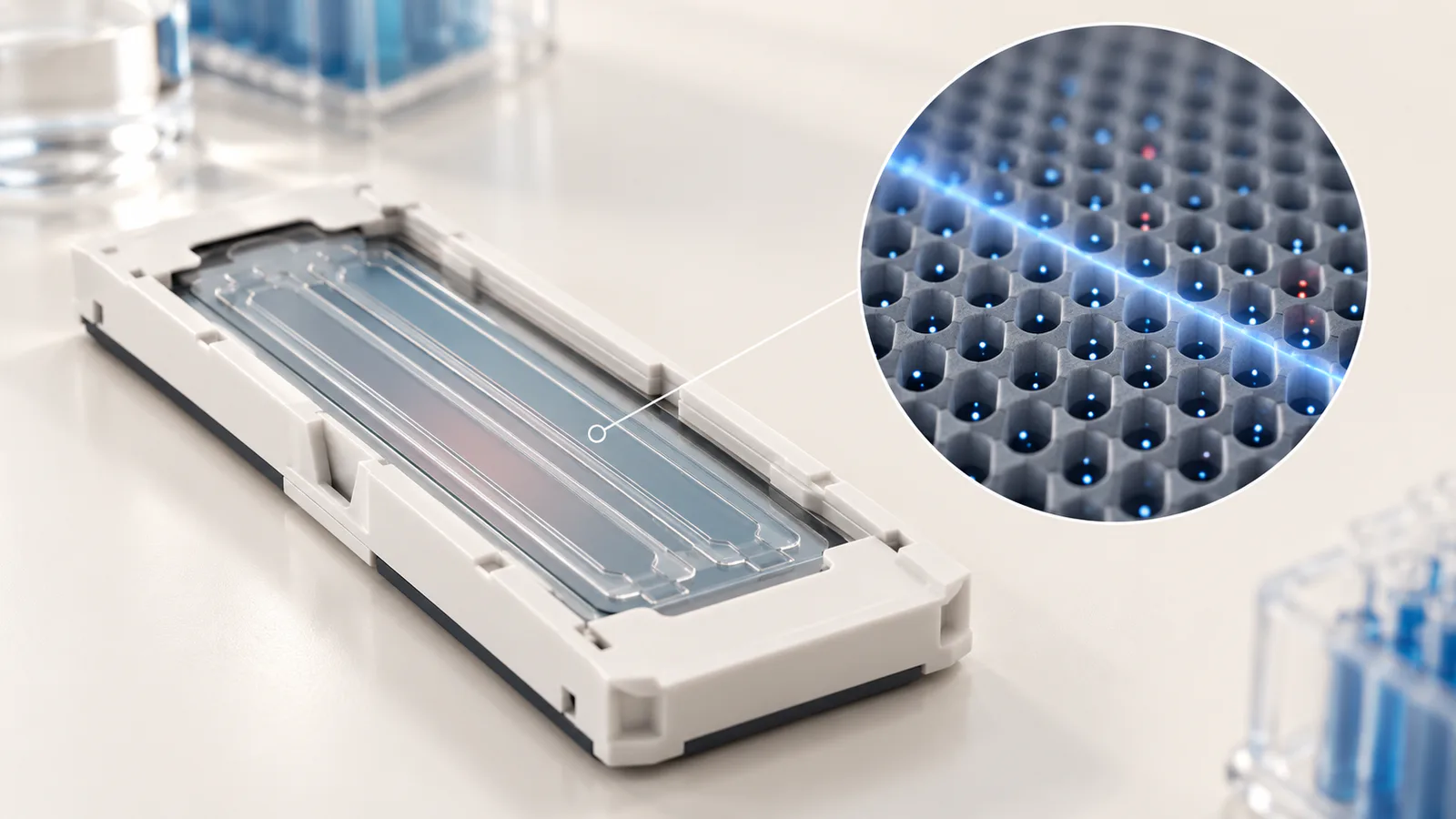
A flow cell is the physical surface or cartridge where prepared DNA or RNA-derived library molecules are loaded and read by a sequencing instrument. Its channels, wells, or nanopores hold the molecules while sequencing chemistry and signal detection occur.
The exact design depends on the platform. Illumina flow cells create and image clusters of copied DNA. Oxford Nanopore flow cells measure electrical changes as individual molecules pass through nanopores.
What is a flow cell in sequencing?
A sequencing flow cell is a consumable device that holds library molecules in a controlled fluidic and sensing environment so an instrument can read their nucleotide sequence.
For Illumina sequencing, the company describes a flow cell as a glass slide with fluidic channels where sequencing chemistry occurs. Library fragments attach to the surface, form clusters, and are imaged cycle by cycle.
For nanopore sequencing, the flow cell contains an array of nanopores connected to electronic sensors. Molecules pass through active pores while current changes are recorded.
The term therefore names a shared function, not one universal object. Every design brings sample molecules, chemistry, and detection hardware together.
What is inside an Illumina flow cell?
An Illumina flow cell contains a glass or patterned surface, immobilized oligonucleotides, fluidic paths, and locations where DNA clusters can form.
Adapter-ligated library fragments bind to complementary oligonucleotides on the surface. Each captured fragment is amplified into a clonal cluster containing many copies of the same starting molecule.
Those copies create enough fluorescent signal for the optical system to detect. During sequencing by synthesis, labeled nucleotides are incorporated, the surface is imaged, and the fluorophore identifies the base added at each cluster.
The process repeats for each cycle. One cycle usually corresponds to one called base per active cluster.
Illumina’s official description of patterned flow cells explains that nanowells fix cluster locations and support very high cluster density. See the patterned flow cell overview.
What are lanes, tiles, wells, and clusters?
Lanes divide a flow cell into fluidically separated regions, tiles divide images into manageable areas, wells define cluster positions on patterned surfaces, and clusters are amplified copies of individual library fragments.
These terms describe different layers of the system. A lane is a physical loading region. A tile is an imaging unit. A well is a potential cluster location. A cluster is the biological signal source.
| Term | What it is | Why it matters |
|---|---|---|
| Flow cell | Complete sequencing surface or cartridge | Sets the platform’s output range and format |
| Lane | Fluidically separated region on some flow cells | Can separate pools or support lane-level planning |
| Tile | Area captured in one imaging field | Tile failures can create localized quality loss |
| Nanowell | Defined cluster position on a patterned surface | Controls cluster spacing and density |
| Cluster | Copies derived from one attached library fragment | Produces the fluorescent signal used for base calling |
| Index read | Read of the sample barcode | Assigns pooled reads back to samples |
Not every instrument exposes lanes in the same way. Some flow cells are partitioned, some support separate lane loading, and others accept one pooled library across the full surface.
Always plan from the specification for the exact instrument, flow cell type, read length, and reagent kit.
How does a sequencing flow cell work?
A flow cell works by immobilizing or guiding library molecules, running repeated sensing chemistry, and converting physical signals into base calls.
In an Illumina run, the simplified sequence is:
- A denatured library is loaded onto the flow cell.
- Fragments bind through their adapters to surface oligonucleotides.
- Each fragment seeds a clonal cluster.
- Sequencing reagents move through the fluidic channels.
- One labeled base is incorporated and imaged per cycle.
- Software converts image intensities into bases and quality scores.
- Index reads assign pooled fragments to samples.
- Paired-end runs regenerate and read the opposite end.
Illumina’s cluster optimization guide states that each fragment seeds a clonal cluster and each cluster yields one single-end read or one paired-end read pair. Read the official guide.
The FASTQ files appear after imaging, base calling, filtering, and demultiplexing. For the full wet-lab context, see RNA-Seq Sample Preparation: RNA Extraction to FASTQ Files.
What is cluster density?
Cluster density is the number of detectable clusters within a defined area of an Illumina flow cell.
Too few clusters wastes imaging capacity and lowers total output. Too many clusters can cause overlapping signals, poor cluster identification, and reduced base-call quality.
Patterned flow cells reduce random spacing by assigning clusters to nanowells. Loading concentration still matters because wells may remain empty or receive competing molecules.
The ideal loading concentration depends on library type, fragment distribution, instrument, chemistry, and whether the library has balanced nucleotide diversity.
More library does not always mean more usable reads
Overloading can reduce the fraction of clusters that pass filter and lower quality. Underloading reduces yield. Follow the loading guidance for the exact flow cell and validate unusual library types empirically.
Why does base diversity matter on an Illumina flow cell?
Base diversity helps the instrument distinguish clusters and calibrate color signals during early sequencing cycles.
A balanced library presents a mixture of A, C, G, and T across clusters at each cycle. Low-diversity libraries may show the same base at many clusters, weakening image registration and color normalization.
Amplicons, small-RNA libraries, and libraries with common adapter-adjacent sequences can have low early-cycle diversity.
Labs may add a balanced control library such as PhiX or redesign pooling to improve diversity. The correct fraction is platform and library dependent.
This issue happens on the flow cell, but it can surface downstream as low quality, poor yield, or unusual per-base composition in FastQC reports.
What is a nanopore flow cell?
A nanopore flow cell is a cartridge containing many nanopore sensing units and the electronics needed to measure ionic current through them.
Each active nanopore sits in a membrane. A motor protein controls how fast a DNA or RNA molecule moves through the pore.
Different nucleotide contexts perturb the current in characteristic ways. Base-calling software converts the signal trace into a sequence.
Oxford Nanopore describes the core sensing system as an array of nanopores coupled to an application-specific integrated circuit, or ASIC. See the official flow cell explanation.
Unlike Illumina clusters, nanopore reads can continue for as long as the molecule and pore remain productive. That supports long reads and direct RNA sequencing, but the signal model and quality controls are different.
Illumina versus nanopore flow cells
Illumina flow cells read clonal DNA clusters optically, while nanopore flow cells read single molecules electrically.
| Feature | Illumina | Oxford Nanopore |
|---|---|---|
| Signal source | Fluorescent nucleotide incorporation | Ionic current disruption |
| Molecule handling | Surface-bound clonal clusters | Single molecules through nanopores |
| Typical read structure | Fixed-cycle single-end or paired-end | Variable-length continuous reads |
| Detector | Optical imaging system | Electronic sensor array |
| Key capacity concept | Clusters passing filter | Active pores and pore productivity |
| Common loading concern | Underclustering or overclustering | Pore occupancy and library capture |
Both devices are called flow cells because liquid samples and reagents interact with a structured sensing surface. The physical mechanism is not interchangeable.
Is one sample loaded per flow cell?
No. Multiple samples are commonly pooled and loaded on the same flow cell using unique index sequences or barcodes.
Pooling improves efficiency because one high-output run can serve many libraries. After sequencing, demultiplexing uses the index reads to assign each read to its sample.
The number of samples is constrained by required reads per sample, expected library balance, index compatibility, and acceptable risk.
If one library dominates the pool, it can consume more reads than planned. Accurate molar quantification and fragment-size measurement are therefore essential before pooling.
Unique dual indexes also reduce incorrect assignments caused by index hopping on compatible platforms.
How do flow cell choices affect experimental design?
Flow cell choice determines the approximate sequencing capacity, supported read lengths, run time, and cost structure of the experiment.
Start with the biological requirement. Estimate reads per sample, number of samples, read layout, and any need for long reads or direct molecule detection.
Then select the platform and flow cell that meet that requirement with reasonable reserve capacity. Do not choose the largest flow cell first and force the study into it afterward.
For bulk RNA-seq, an underpowered run may reduce sensitivity for low-abundance transcripts. Excess depth cannot repair weak replication or confounded study design.
The flow cell is therefore one budget and capacity decision inside a larger experiment. It does not replace sound RNA-seq experimental design.
Can a sequencing flow cell be reused?
Reuse depends on the platform and flow cell type. Many short-read flow cells are single-use consumables, while some nanopore workflows allow washing and reloading when enough pores remain active.
Reuse never means the device returns to its original state. Residual material, declining pore availability, contamination risk, and run requirements must be considered.
Follow the manufacturer’s current protocol for the exact product. A practice supported for one flow cell cannot be generalized to another.
How can you tell if a flow cell performed well?
A good run produces the expected number of usable reads with acceptable quality and even representation across planned samples.
For Illumina data, inspect clusters passing filter, percentage of bases at or above Q30, error rate, yield, index balance, and quality by cycle, lane, and tile.
Localized tile problems can indicate bubbles, debris, focus issues, or surface defects. Global quality decay may reflect chemistry, library, or run setup.
For nanopore data, inspect active pores, pore occupancy, read count, yield over time, read-length distribution, and base-call quality.
The run dashboard gives instrument-level evidence. FASTQ quality control then asks how those effects appear in the reads used for analysis.
Key takeaways
A flow cell is where sequencing molecules, chemistry, and detection meet.
Illumina flow cells use surface-bound clusters and optical sequencing by synthesis. Nanopore flow cells use pore arrays and electrical sensing of single molecules.
Loading concentration, cluster density or pore occupancy, library diversity, and pooling can all change usable output.
Choosing a flow cell is an experimental design decision because it sets capacity, read structure, run time, and part of the study cost.
Further reading
Read another related post
RNA-Seq Analysis Without a Bioinformatician: What to Automate
If your lab sequences more than it analyzes, here is what self-service RNA-seq looks like, what is safe to automate, and where you still need a human.
TutorialSTAR vs Salmon vs HISAT2: A Hands-On Benchmark
A hands-on RNA-seq aligner benchmark: working STAR, Salmon, and HISAT2 commands, real runtime and memory numbers, and how much the DEG list actually changes.
Research GuideRNA-Seq Results Checklist for Publication and Peer Review
Reviewers reject RNA-seq papers for predictable reasons: missing FDR correction, version-less methods, inaccessible data. A checklist that prevents it.